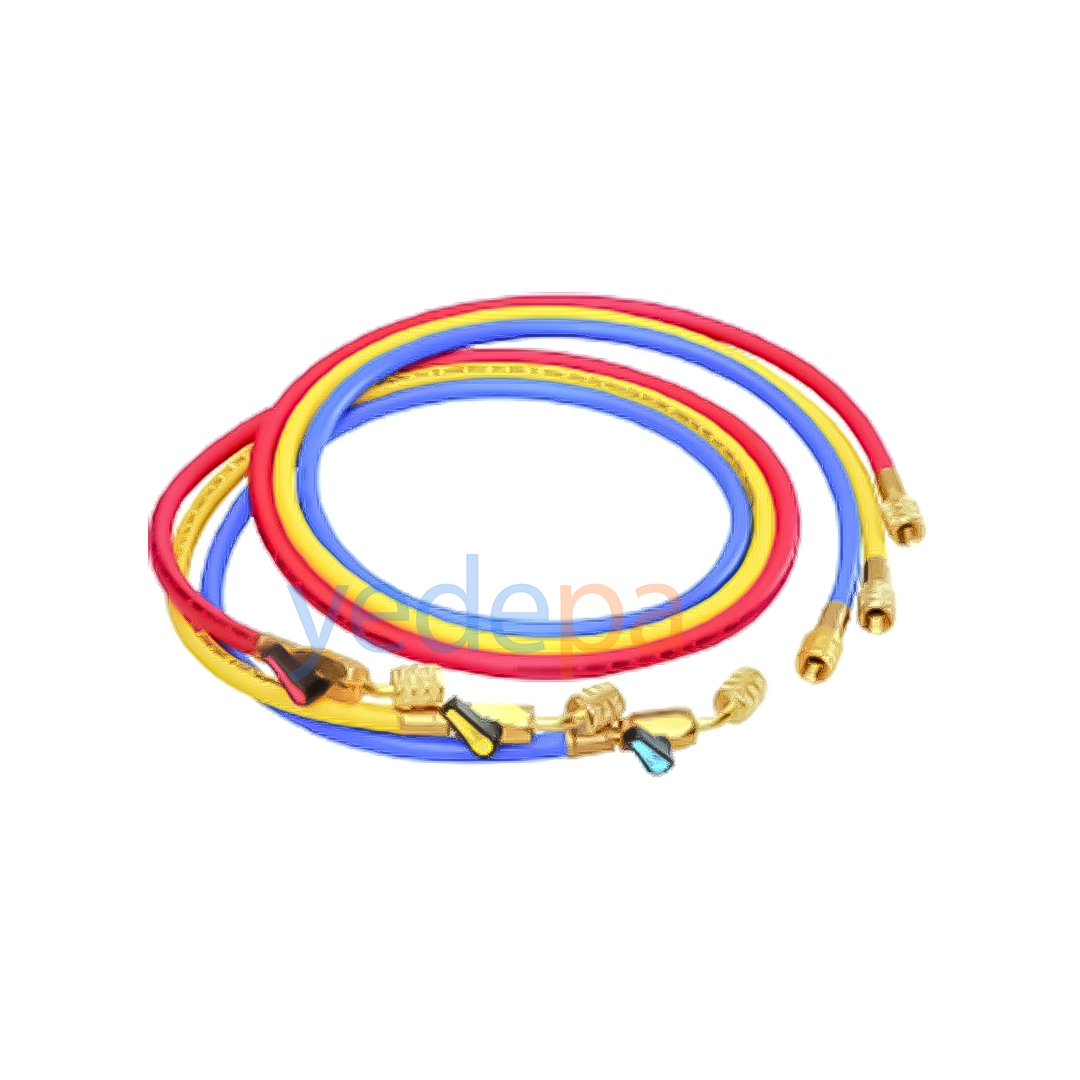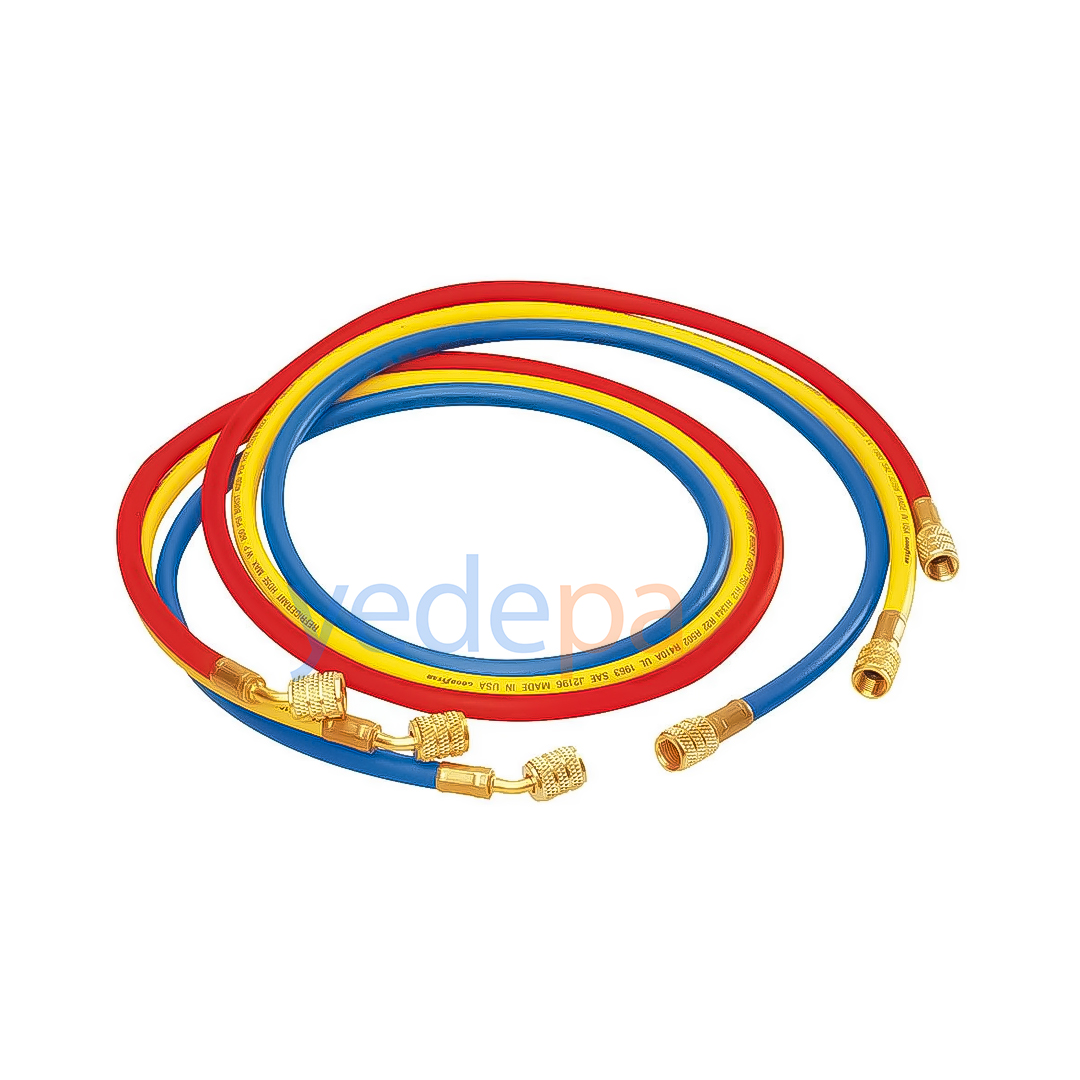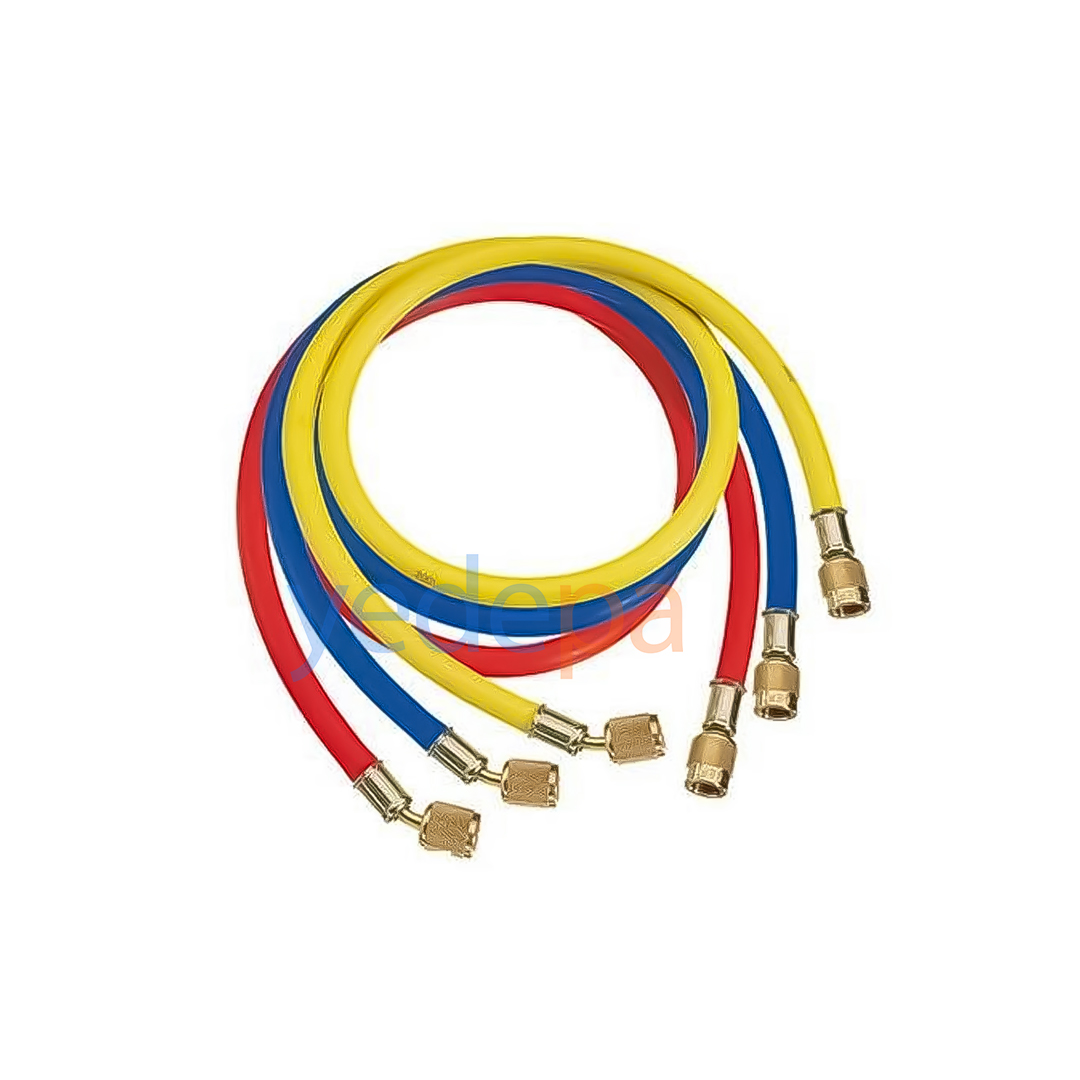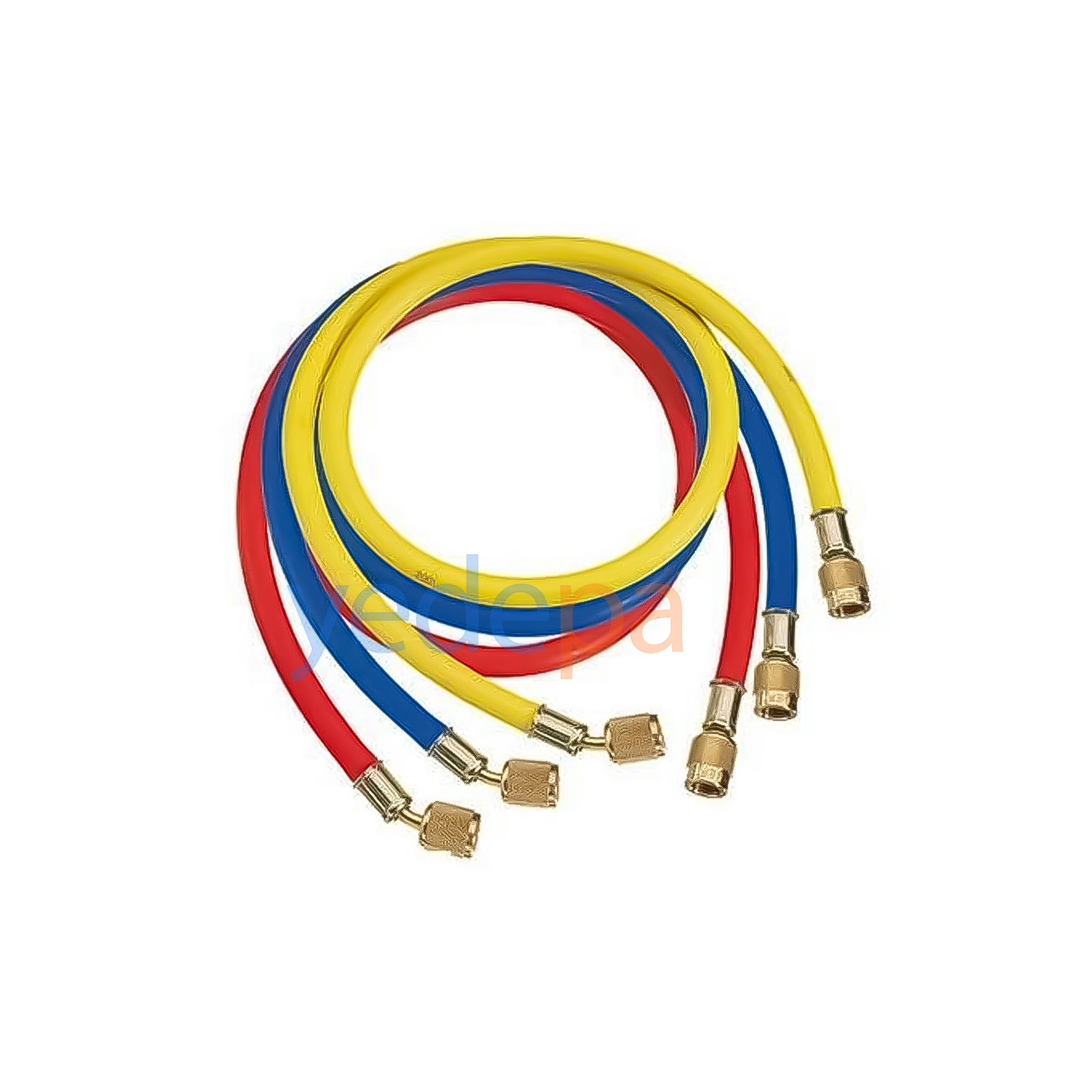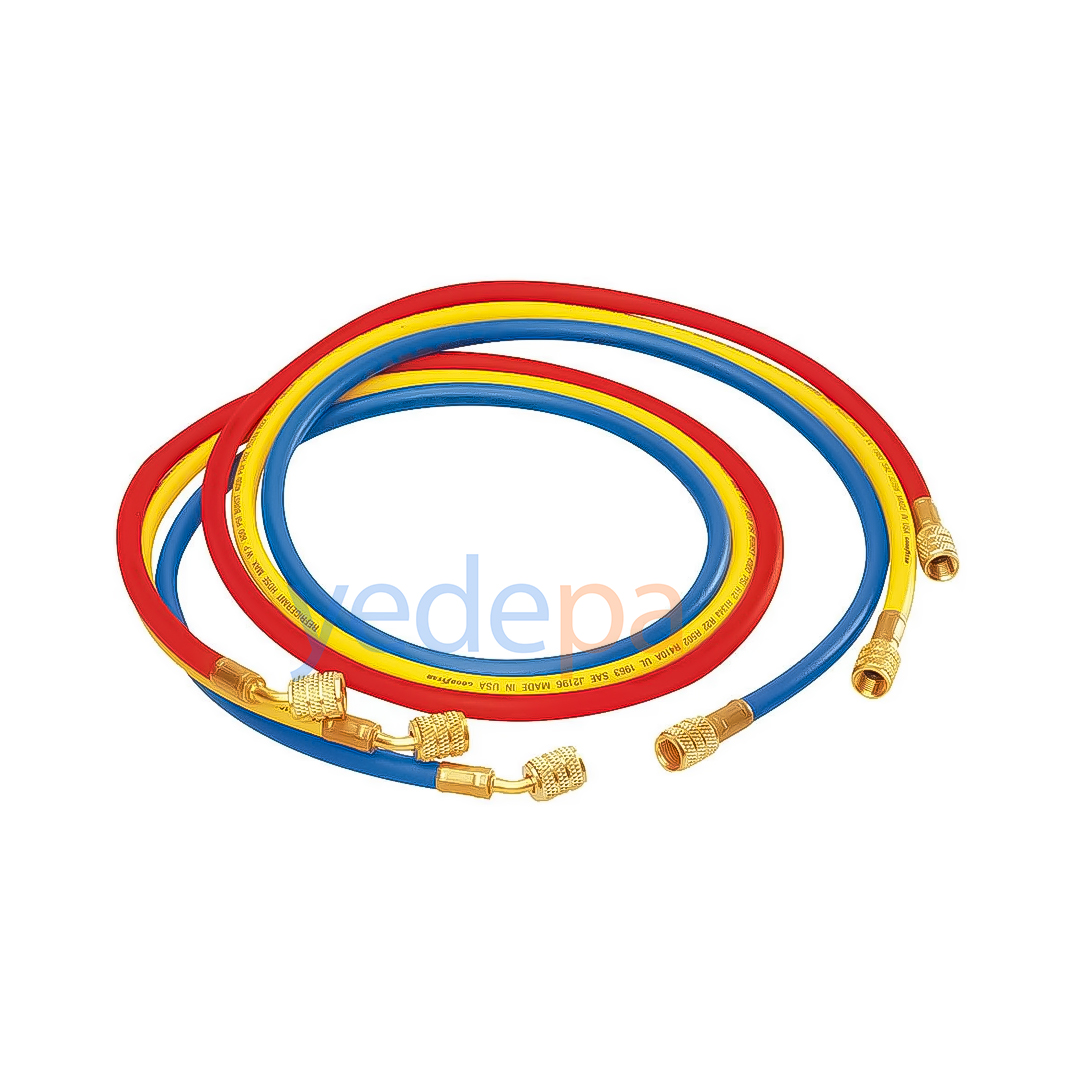
What Are Charging Hoses? The Indispensable Connection Element of HVAC Service
Charging hoses are special high-pressure-resistant hoses that act as a bridge between the manifold set and the refrigerant cylinder, air conditioner outdoor unit or vacuum pump so that service operations such as refrigerant charging, evacuation, pressure measurement and leak testing can be carried out safely in refrigeration and air conditioning systems. At Yedepa.com, we offer charging hoses, one of the most critical consumables HVAC technicians encounter in the field every day, under one roof with brands of proven reliability in the industry such as Rothenberger, Value and Hengsen.
An air conditioning technician's bag should contain charging hoses in at least three colors: red (high pressure), blue (low pressure) and yellow (center service line). This three-hose arrangement forms the standard working layout of the manifold set. Hose quality affects not only durability but also directly affects the accuracy of pressure values read in the field, the prevention of refrigerant loss and the shortening of service time.
Technical Details and Operating Principle of Charging Hoses
Refrigerant charging hoses used in the HVAC sector are generally manufactured to a working pressure of 800 PSI and a burst pressure of 4000 PSI. They have a nylon-reinforced rubber core inside and a UV- and oil-resistant synthetic jacket on the outside. This multi-layer construction makes the hose resistant both to the chemical effect of the refrigerant and to mechanical impacts under field conditions.
The fittings at the hose ends are manufactured to the 1/4" SAE or 5/16" SAE standard. While a 5/16" connection has become mandatory for high-pressure new-generation refrigerants such as R410A and R32, 1/4" connections are common for classic refrigerants such as R22, R134a and R404a. Although the operating principle looks simple, in practice it requires precise engineering: when the valves on the manifold set are opened, the refrigerant is transferred into the system through the hose in a controlled manner; during measurement, the pressure is transmitted to the gauge.
Charging Hose Types and Model Variants
Depending on the needs encountered in the field, charging hoses are divided into several main categories. The right choice determines both service quality and occupational safety:
- Standard Manifold Hose Sets: Without valves, for conventional use. Economical and ideal for general service work.
- Hose Sets with Ball Valves: There is a ball valve at the end of the hose. It reduces refrigerant loss to zero when disconnecting; the choice of professional technicians.
- Hoses with Check Valves (Non-Return Valves): Provide one-way flow. Prevent atmospheric air from leaking back into the system during evacuation.
- R410A Compatible 5/16" High Pressure Hoses: Mandatory for new-generation inverter air conditioners and VRF systems.
- Three-Color Coded Sets: In the Blue-Red-Yellow standard, they cover all lines of the manifold set.
Length options vary between 90 cm, 120 cm, 150 cm, 180 cm and 300 cm. While a short hose is insufficient for ceiling-type split air conditioners, models such as the 300 cm long Value VRP-U-R/B/Y 300cm are lifesavers in VRF plant rooms or industrial refrigeration systems.
Which Charging Hose Model Should You Choose? Decision Guide
To choose the right hose, you need to answer three basic questions: Which refrigerant am I working with?, How often do I do service work? and What is my connection standard?
- Determine the refrigerant type: If you work with R410A or R32, always choose a high-pressure-resistant set with 5/16" SAE connections. For R22, R134a and R404a, 1/4" SAE is sufficient.
- Decide on the valve type: For a professional technician doing 3-5 service calls a day, models with valves or check valves provide both refrigerant savings and faster work.
- Choose the length according to your work: 150 cm is ideal for residential split air conditioners; 180-300 cm should be preferred for industrial applications.
- Consider the brand assurance: Rothenberger offers certified German manufacturing, Value offers affordable quality Asian manufacturing, and Hengsen offers an economical solution for B2B customers.
Charging Hoses Available at Yedepa.com
Yedepa.com offers a rich portfolio of charging hoses to HVAC technicians and refrigeration technicians throughout Turkey. The featured models in our stock are:
- Rothenberger 1500000030 Manifold Hose Set with Valves 1500mm 5/16" R410A - R32 — A professional solution for new-generation inverter air conditioners. Thanks to its ball valve design, refrigerant loss drops to zero.
- Rothenberger 1500000034 Plus Manifold Hose Set with Valves 1800mm 1/4" — A long-reach premium set with valves for R22 and R134a systems.
- Rothenberger 1500000033 Standard Manifold Hose Set 1800 mm 1/4" — An economical and durable choice for conventional air conditioner service.
- Rothenberger 1000050005 Standard Manifold Hose 5/16" SAE 900 mm Set of 3 — A compact three-hose set for short-distance service work.
- ROTHENBERGER 2100221 Manifold Hose Set 900mm 1/4" - 5/16" R410A Compatible — A practical solution with mixed connections, compatible with both old and new-generation refrigerants.
- Rothenberger 1000050003 Standard Manifold Hose Set 1/4" SAE 900mm — Budget-friendly, reliable German quality.
- Value VRP-U-R/B/Y Charging Hose 300cm (R22) — A long-distance solution for industrial applications.
- HVAC Refrigerant Charging Hose Set with Valves 150 cm – Artiko LX Hose R410 / R134 Compatible — An economical set with valves from the Hengsen brand.
- Value VRP-C-R/B/Y Charging Hose 120cm with Check Valve — A professional model that prevents backflow during evacuation.
- Value VRP-C-R/B/Y Charging Hose 90cm with Check Valve (R22) — An economical short-distance choice with a non-return valve.
Professional Selection Criteria and Comparison Table
The comparison table below clearly shows which model stands out in which scenario in the field:
| Model | Length | Connection | Valve Type | Compatible Refrigerant |
|---|---|---|---|---|
| Rothenberger 1500000030 | 1500 mm | 5/16" SAE | With valves | R410A, R32 |
| Rothenberger 1500000034 Plus | 1800 mm | 1/4" SAE | With valves (Ball) | R22, R134a |
| Rothenberger 1500000033 | 1800 mm | 1/4" SAE | Standard | R22, R134a |
| Rothenberger 2100221 | 900 mm | 1/4" - 5/16" | Standard | R410A |
| Value VRP-U 300cm | 3000 mm | 1/4" SAE | Standard | R22 |
| Value VRP-C 120cm | 1200 mm | 1/4" SAE | With check valve | R410A, R134A, R12, R22 |
| Hengsen Artiko LX 150cm | 1500 mm | 1/4" SAE | With valves | R410, R134 |
The criteria to consider in a professional selection are: working pressure (min 800 PSI), burst pressure (min 4000 PSI), quality of the fitting seal, hose flexibility and UV resistance. All the charging hoses we sell at Yedepa.com meet these criteria.
Usage and Maintenance Recommendations
To extend the life of charging hoses and prevent unexpected accidents in the field, the following maintenance rules should be observed:
- Carry out a visual inspection before every service: Do not use the hose if there are cracks or bulges, or if the fitting end is crushed.
- Seal (O-ring) check: The rubber seals at the fitting ends should be replaced once a year. Yedepa.com also keeps these spare seals in stock.
- Pay attention to tightening torque: Overtightening the fittings causes seal deformation. After hand-tightening, a final 1/4 turn is made with a wrench.
- Storage conditions: Do not leave hoses in direct sunlight or next to chemicals such as battery acid.
- Cleaning before evacuation: If there is moisture or refrigerant residue left in the hose from a previous service, the evacuation time increases; models with check valves minimize this problem.
- Follow the color codes: Blue low pressure, red high pressure, yellow service line – mixing up the codes leads to diagnostic errors.
Why Is a 5/16" Hose Essential for R410A and R32?
New-generation environmentally friendly refrigerants (especially R32 and R410A) have much higher operating pressures than classic R22. In R410A systems, values of 30-35 bar can be reached on the high pressure line. Under this pressure a 1/4" SAE connection is inadequate; both the risk of leakage increases and the charging speed decreases. Models with 5/16" SAE connections such as the Rothenberger 1500000030 are specially designed for these new refrigerants and are essential in terms of both safety and work efficiency.
Frequently Asked Questions (FAQ)
Question 1: How often should I replace my charging hose?
2-3 years is recommended for professional use and 5 years for amateur/occasional use. However, if cracks or seal deformation are seen, it should be replaced without waiting.
Question 2: Can I use a 1/4" hose on an R410A system?
In a short-term emergency it can be connected with an adapter, but this is not recommended. Due to the high pressure, both measurement errors and safety risks arise. You need to get a 5/16" model.
Question 3: What is the difference between a hose with valves and a hose with check valves?
In models with valves, the ball valve is opened and closed manually; it reduces refrigerant loss to zero. In models with check valves, there is one-way flow; it prevents atmospheric leakage, especially during the evacuation stage.
Question 4: Is there a quality difference between Rothenberger and Value?
Rothenberger is a premium brand of German origin aimed at heavy industrial use. Value is of Chinese origin but is an economical-to-mid-segment brand with global recognition in the HVAC sector. Both are reliable for daily use; Rothenberger is recommended for heavy job site conditions.
Question 5: How do I determine the hose length?
Take the height of the outdoor unit you are working on + the distance to the cylinder + an extra 30 cm allowance. For ceiling-type VRFs 180-300 cm is sufficient, and for residential splits 90-150 cm.
Question 6: Is refrigerant residue inside the hose dangerous?
It is not directly dangerous; however, if a new refrigerant type is to be charged, the residue inside the hose should be evacuated with a vacuum. Otherwise, refrigerant mixing leads to reduced performance in the system.
Question 7: Which standards does the hose I order from Yedepa.com comply with?
All hoses in our stock are manufactured in compliance with the SAE J2196 and EN ISO 14903 standards.
Conclusion and Yedepa.com Advantages
Charging hoses are invisible but vitally important parts of HVAC service. A wrongly selected hose or one that is not replaced in time can damage your service reputation by causing both refrigerant loss and pressure measurement errors in the field. For this reason, Yedepa.com, which brings together leading brands of the industry such as Rothenberger, Value and Hengsen on a single platform, continues to be the right address for technicians.
When choosing a charging hose at Yedepa.com, you benefit from the following advantages:
- Brand variety: Premium German (Rothenberger), global mid-segment (Value) and economical B2B (Hengsen) options.
- Expert support line: Technical advice by phone/WhatsApp for the model you are unsure about.
- Stock assurance: Instant stock information when you urgently need it in the field.
- Catalog focused on service companies and technicians: Not an ordinary e-commerce site; a product portfolio curated by a team that knows the industry.
- Spare seal and accessory compatibility: Together with the hose, you can complete fitting seals, adapters and manifold sets in the same cart.
If you want to move to a professional level in your HVAC career, you need to start with quality equipment. At Yedepa.com, we deliver this basic consumable, which should be in every technician's bag, to your door with the best brands in the industry. For your questions, you can contact our customer representatives or easily choose the charging hose that suits you best by reviewing the product details on the category page.
🛒 Charging Hoses at Yedepa.com — Featured Products
The most preferred professional products, selected from our stock. View and order now.