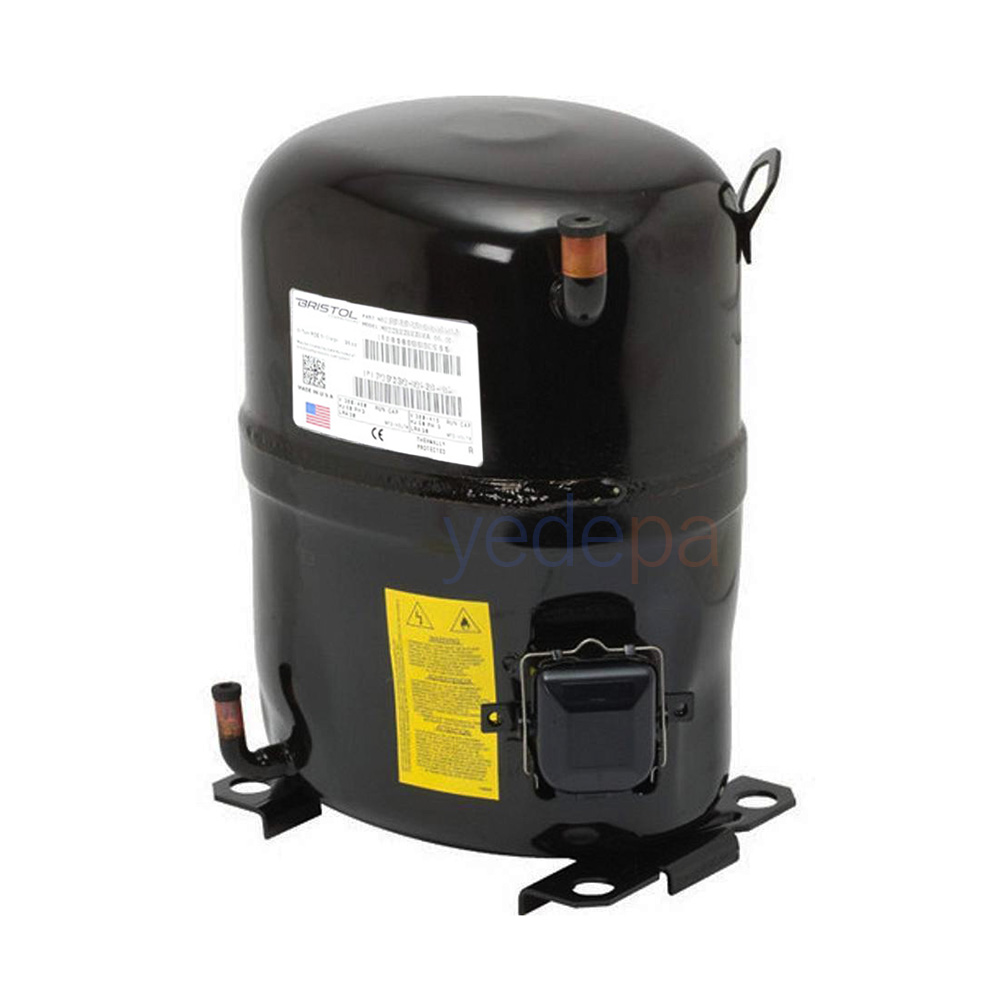
What Is a Bristol Hermetic Compressor?
Bristol hermetic compressors are a US-origin industrial compressor family that has been a reference point in commercial refrigeration and air conditioning applications for decades. Bristol Compressors Inc. was founded in 1948 in the state of Virginia and for many years served the commercial air conditioning sector as an independent manufacturer. Today the company operates under the ownership of Toshiba Carrier; this ensures that the Bristol motor-compressor group is developed according to Carrier's global engineering standards.
A hermetic compressor is a closed-type compressor in which the motor and compression group are mounted together inside a welded, sealed steel shell. It is not designed to be opened and repaired; therefore, field teams treat it as a 'replacement part'. As Yedepa.com, we take care to stock the Bristol models we encounter most often in commercial air conditioning, packaged air conditioning, rooftop, cold room and supermarket refrigeration projects in three different configurations: with original valves, with suction-discharge valves and without valves.
Hermetic, Semi-Hermetic and Scroll Compressor Differences
Before choosing a Bristol model, it is necessary to clarify the difference between the three basic compressor architectures that are often confused in the field. For HVAC technicians and refrigeration technicians, let us briefly summarize these differences:
- Hermetic (closed-type) compressor: The motor and piston group are inside a welded shell; there is no disassembly. The Bristol H92G, H2NG, H7BG and H2BG series are in this class.
- Semi-hermetic compressor: The type that can be opened via bolted covers and whose valve plate and piston rings can be replaced. Mostly preferred in large-tonnage industrial refrigeration.
- Scroll compressor: Works with a pistonless, spiral architecture; vibration and noise levels are low, but in case of failure the compressor is replaced completely.
Bristol's main expertise is reciprocating hermetic technology. This architecture is still a preferred solution, especially in rooftop and packaged air conditioning applications between 8 HP and 20 HP, in terms of durability at high compression ratios, part-load performance and a field database accumulated over decades.
Bristol Series Codes: H92G, H2NG, H7BG, H2BG
Although Bristol's model naming looks complicated at first, it actually has a multi-layered and readable structure. As Yedepa.com, let us explain the series we encounter most in the field:
H92G Series
The H92G family is a high-efficiency R407C / R22 compatible series designed for medium-to-high tonnage (between 10 HP and 20 HP) commercial air conditioning and heat pump applications. 20 HP Bristol Compressor H92G 244 DREF, 16 HP Bristol Compressor H92G 204 DREF and 10 HP Bristol Compressor H92G 124 DBEE models are the most sought-after members of this series in the field.
H2NG Series
H2NG is a series that stands out especially in the 14 HP and 16 HP segments, in packaged air conditioning and rooftop applications. 16 HP Bristol Compressor H2NG 204 DREF and 14 HP Bristol Compressor H2NG 184 DPEE models are among the most frequently sought replacement parts at older installation sites in Turkey.
H7BG and H2BG Series
H7BG and H2BG are aimed at smaller-tonnage commercial air conditioning, cold room and special process applications in the 8 HP to 10 HP range. 9 HP Bristol Compressor H7BG 104 DBEE, 8 HP Bristol Compressor H7BG 094 DBEE and 8 HP Bristol Compressor H2BG 094 DBEE are the members we encounter most often in the field. Since these series offer high durability at low tonnage, replacement demand is not decreasing as the installed base ages; on the contrary, it is increasing.
Valve Type Selection: With Original Valves, With Suction-Discharge Valves, Without Valves
When sourcing a Bristol compressor, the most critical decision for the technician is the unit's valve configuration. As Yedepa.com, we offer the same motor-pump group with three different heads, because field reality requires it:
- With Original Valves (rotalockable / OEM service valves): Comes out of Bristol's factory with the original service valves designed by the manufacturer. Recommended for warranty-focused retrofits and new installations.
- With Suction-Discharge Valves (rotalock): Comes with field-compatible suction and discharge valves with standard rotalock connections. Fits the existing piping in most retrofit jobs.
- Without Valves (stub tube): The compressor comes directly with tube stubs; the technician connects it to the piping by brazing in the field. It is the fastest solution in breakdown-replacement jobs where the piping has not changed.
A wrong valve selection can turn into a scenario where the compressor has been lifted and lowered by crane in the field, but the job is left half-finished because the piping does not match. That is why, in the Yedepa.com catalog, for each Bristol model the valve type is clearly labeled; nothing is left to guesswork.
HP, BTU and Cooling Capacity Relationship
In Bristol compressor selection, HP (Horsepower) roughly represents the motor power of the compressor, while BTU/h expresses the cooling capacity. For practical conversion, the following approximate values are used in the field:
| HP | Approx. Motor kW | Approx. Cooling Capacity (BTU/h) | Typical Application |
|---|---|---|---|
| 8 HP | ~6 kW | ~96,000 BTU/h | Small commercial air conditioning / cold room |
| 9 HP | ~6.7 kW | ~108,000 BTU/h | Restaurant / store packaged air conditioner |
| 10 HP | ~7.5 kW | ~120,000 BTU/h | Medium-scale commercial air conditioning |
| 14 HP | ~10.4 kW | ~168,000 BTU/h | Rooftop / large store |
| 16 HP | ~11.9 kW | ~192,000 BTU/h | Industrial packaged air conditioner |
| 20 HP | ~14.9 kW | ~240,000 BTU/h | Large rooftop / process cooling |
These values are approximate for nominal conditions (ARI / standard evaporating-condensing temperatures). The actual capacity varies according to the refrigerant type, evaporating temperature and condensing pressure. As Yedepa.com, we provide the detailed capacity table together with the documentation on the relevant compressor page.
What Do the DREF, DPEE, DBEE Suffix Codes Mean?
The 4-letter code at the end of the Bristol model name (such as DREF, DPEE, DBEE) is a string of characters showing the electrical and mechanical configuration of the compressor. It can be read with field logic:
- First letter (D): Generally defines the shell / mounting configuration.
- Second letter (R / B / P): Represents the motor winding type or lubrication system.
- Third letter (E): Mostly indicates refrigerant / oil compatibility.
- Fourth letter (F / E): Shows the voltage and phase combination (e.g. 380-420V / 3 phase / 50 Hz).
In practice, what is critical for the technician is this: even if you see two compressors of the same tonnage, you may experience electrical incompatibility if the suffix code is different. For example, 10 HP Bristol Compressor H92G 124 DBEE and a compressor of the same tonnage with a DREF suffix may not deliver the same motor performance. As Yedepa.com, we clearly state the full suffix code for all Bristol models in our product list, so that there is no risk of the compressor turning out to be incompatible with the installation when the technician receives it at the door.
Yedepa Bristol Compressor Models Comparison Table
In the table below, we have summarized the Bristol models most frequently requested in the field together with tonnage, series code and valve type:
| Tonnage | Model | Suffix | Valve Type |
|---|---|---|---|
| 20 HP | H92G 244 | DREF | With Original Valves |
| 16 HP | H92G 204 | DREF | With Original Valves |
| 16 HP | H2NG 204 | DREF | With Original Valves |
| 14 HP | H2NG 184 | DPEE | With Original Valves |
| 10 HP | H92G 124 | DBEE | With Original Valves |
| 10 HP | H92G 124 | DBEE | With Suction - Discharge Valves |
| 10 HP | H92G 124 | DBEE | Without Valves |
| 9 HP | H7BG 104 | DBEE | Without Valves |
| 8 HP | H2BG 094 | DBEE | With Suction - Discharge Valves |
| 8 HP | H2BG 094 | DBEE | Without Valves |
| 8 HP | H2BG 094 | DBEE | With Original Valves |
| 8 HP | H7BG 094 | DBEE | With Suction - Discharge Valves |
Bristol Selection Criteria for HVAC Technicians
When replacing a Bristol compressor in the field, we recommend that the technician follow the steps below for the job to turn out right:
- Photo of the old compressor's label: The model, suffix code and voltage information should be read from the label; there is no room for guesswork.
- Piping size measurement: The existing suction-discharge pipe diameter should be determined; this determines the valve type selection.
- Refrigerant type identification: R22, R407C, R410A — the gas used in the system directly affects compressor selection.
- Oil compatibility: Whether mineral oil or POE was used, the system history should be asked about.
- Valve configuration decision: The most suitable of the original valves / suction-discharge valves / no valves options is chosen according to the piping and time constraints.
If you order a Bristol compressor from Yedepa.com by following these five steps, the likelihood of experiencing incompatibility during installation drops significantly. For the service teams of our B2B customers, we also share a checklist containing these steps on request.
Why Is Spare Part (With Valves / Without Valves) Selection Important?
Whether you order a Bristol compressor with valves or without valves is not a decision consisting only of a price difference. It directly affects the job completion time in the field, brazing quality and customer satisfaction:
- A compressor without valves is cheaper because it has no service valves. If the piping is already suitable for a tube-stub joint, it is quickly commissioned by brazing.
- A compressor with suction-discharge valves offers additional flexibility; it is possible to isolate the system for future maintenance.
- A compressor with original valves is a guaranteed starting point within the manufacturer's tolerances; it is preferred in new installations and large projects.
That is also why the same Bristol model is stocked at Yedepa.com with three different valve options. For example, the 10 HP H92G 124 DBEE is in our list with original valves, with suction-discharge valves and without valves versions. The technician sees the piping and orders the most suitable one; no unnecessary parts go to the field.
Bristol Compressor Commissioning and Maintenance Notes
The long life of Bristol hermetic compressors depends largely on the correct commissioning procedure. Our field experience shows that the most common causes of early failure stem from the following points:
- Insufficient vacuum: Commissioning the system without evacuating it below 500 microns weakens the winding insulation in the long term.
- Oil contamination: If oil and moisture remaining from the old system reach the winding of the new compressor, this leads to early failure.
- Wrong phase sequence: In 3-phase models, reverse rotation causes the compressor to go out of service within minutes.
- Overheated operation: Not controlling the condensing pressure causes the thermal protection circuit to trip constantly and eventually burns out the motor winding.
As Yedepa.com, we recommend that services sourcing Bristol compressors apply this checklist regularly. A correctly commissioned Bristol is known as a part that can run trouble-free in the field for decades — the fact that the H2BG and H7BG series installed long ago in the sector are still sought as replacements is the most concrete proof of this.
Frequently Asked Questions (FAQ)
In which country are Bristol compressors manufactured?
Bristol Compressors Inc. was founded in 1948 in the state of Virginia, USA. Today the company operates within Toshiba Carrier; production and engineering standards are managed by the global Carrier network.
Which of two Bristol compressors of the same tonnage with different valve types should I buy?
This decision depends entirely on the condition of your existing piping. If the piping has tube stubs and will not be changed, we recommend the model without valves; if there are rotalock connections, the model with suction-discharge valves; and if you are planning a new installation or a warranted conversion, the model with original valves.
What is the difference between the 10 HP H92G 124 DBEE and the 8 HP H2BG 094 DBEE?
Although both come from the same motor family, the tonnage, cooling capacity and series design are different. The 10 HP H92G is aimed at medium-to-upper tonnage applications, while the 8 HP H2BG is aimed at smaller commercial air conditioning and refrigeration systems. They cannot be directly interchanged; the system design must have been selected accordingly.
Are spare Bristol compressors still available?
Yes. Since Bristol motor-pump groups are still in production, many tonnages of the H92G, H2NG, H7BG and H2BG families can still be supplied new. In the Yedepa.com catalog, we list the 12 most frequently requested tonnage-valve combinations as ready stock.
Which refrigerants are Bristol compressors compatible with?
Although it varies by model series, most of the H92G, H2NG, H7BG and H2BG families are compatible with R22, R407C and, in selected versions, R410A. For correct gas selection, Bristol's model-specific application guide document should be taken as the basis; changing the gas based on guesswork in the field is not recommended.
If I buy a Bristol compressor without valves, how is it connected to the piping?
In models without valves, the suction and discharge ends come as tubes; the technician connects them to the existing copper piping with silver brazing in the field. This method is the fastest solution in breakdown-replacement jobs where the piping does not change, and it is also the most cost-effective.
🛒 Bristol at Yedepa.com — Featured Products
The most preferred professional products, selected from our stock. Browse and order now.