What Are Plate Heat Exchangers? The Heart of the Combi Boiler System
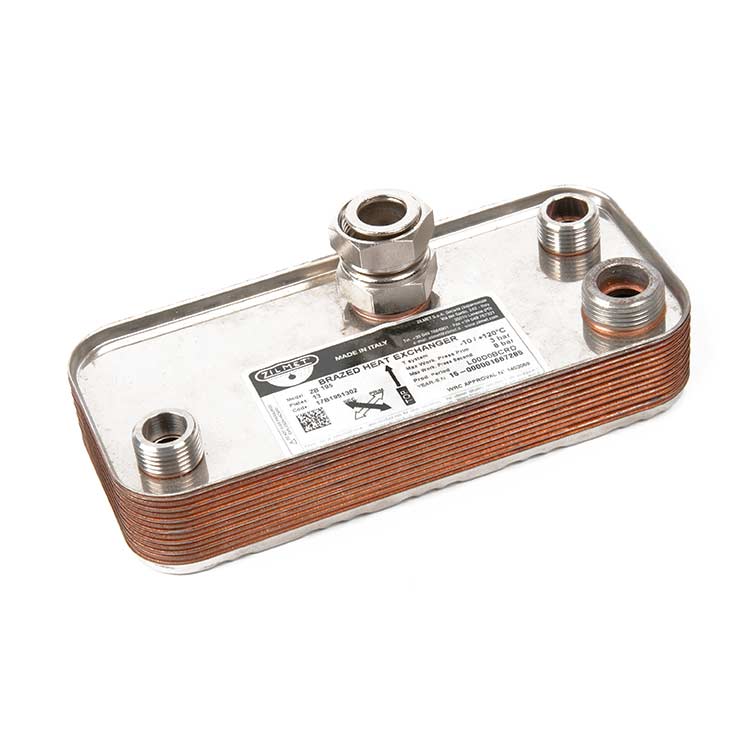
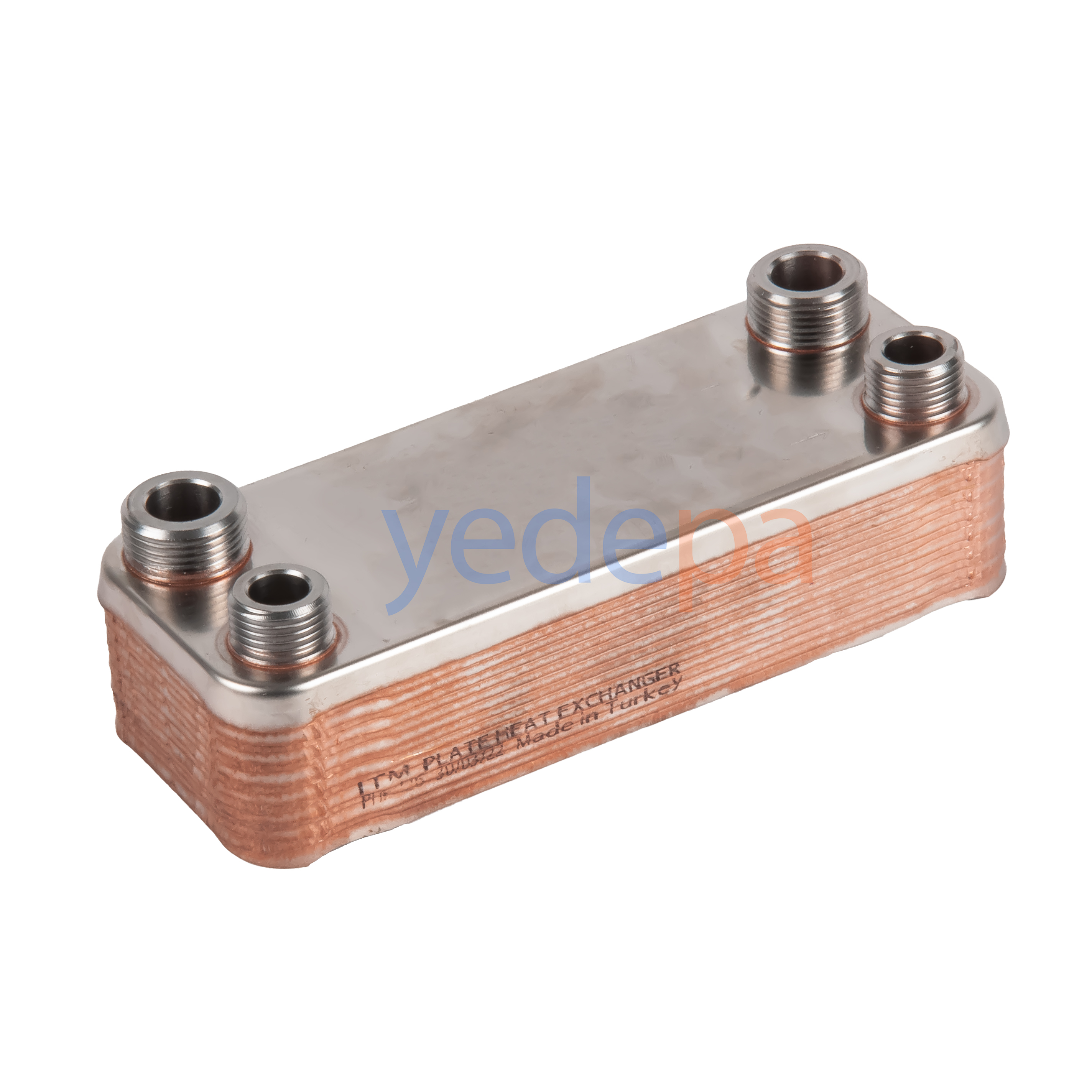
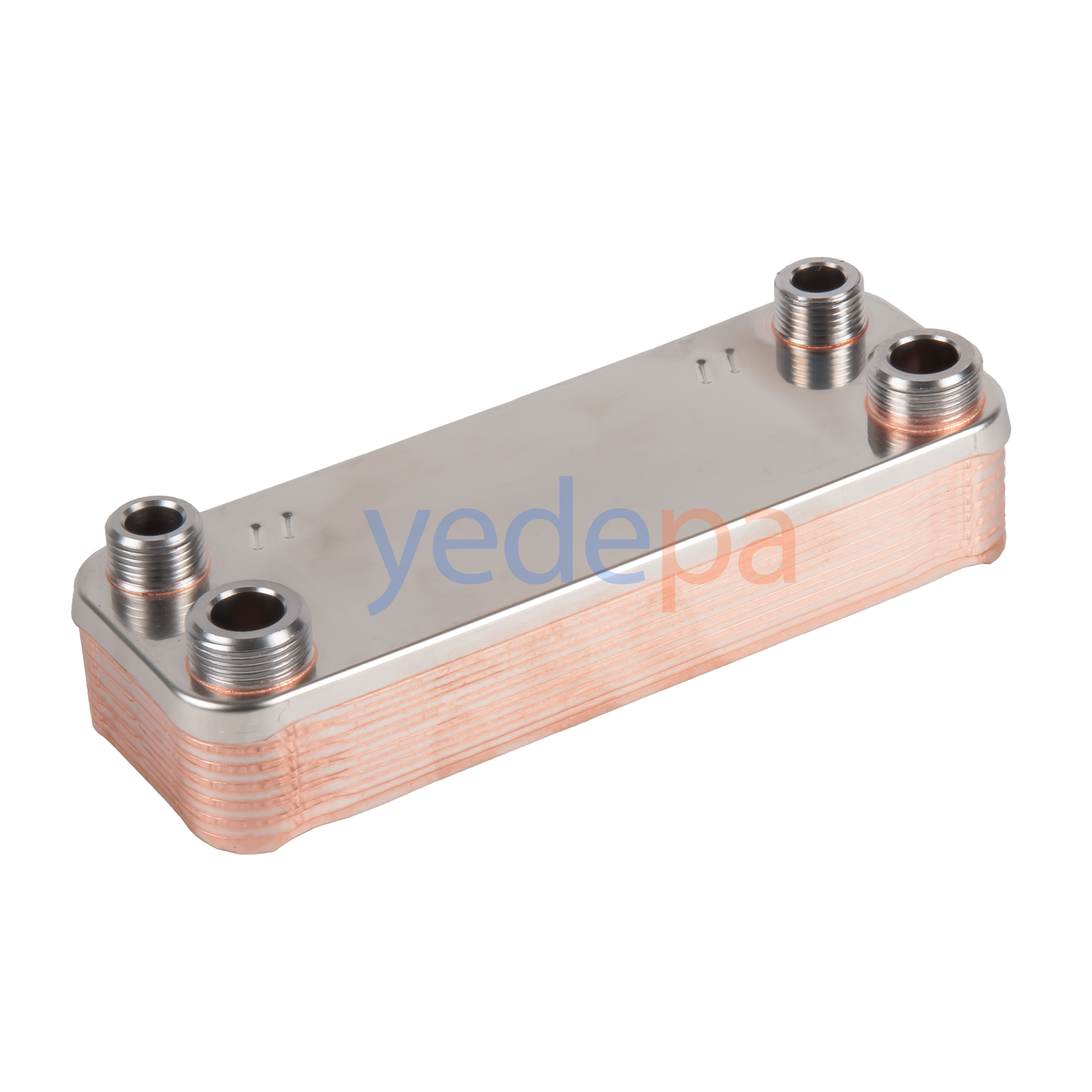
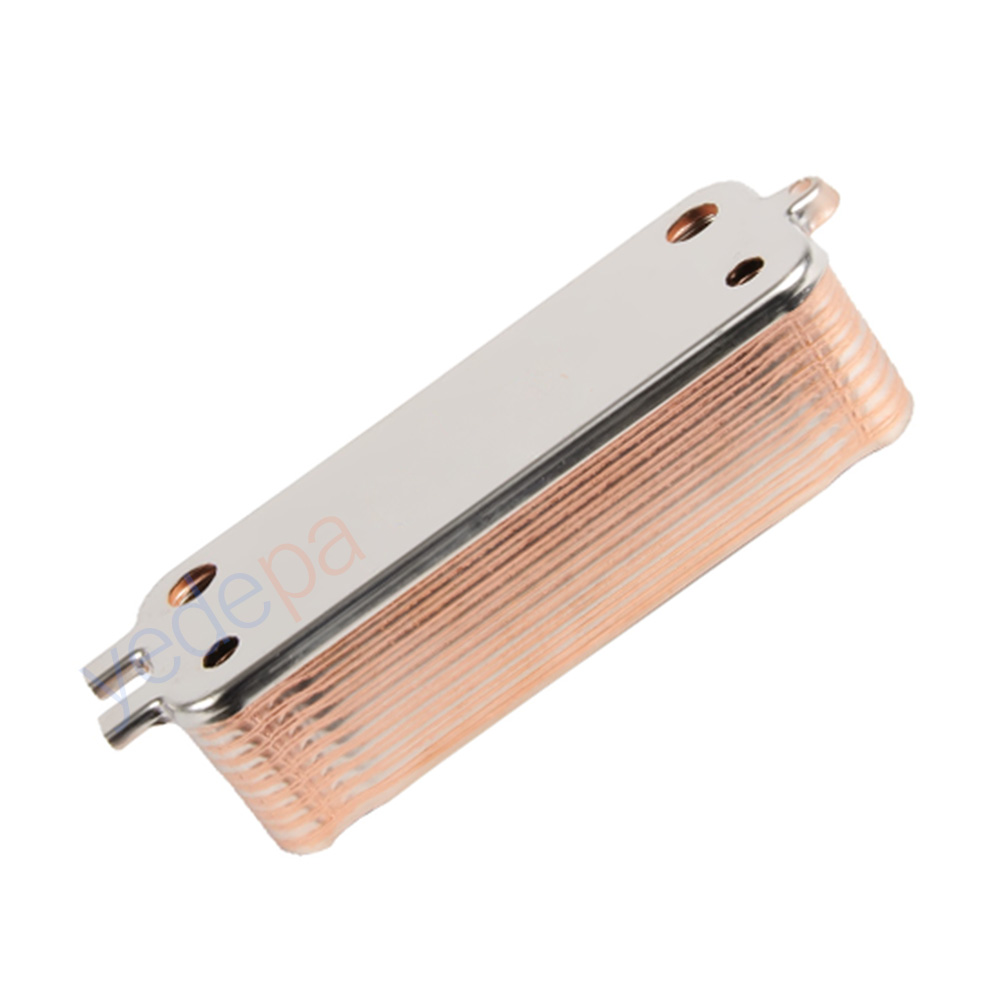
A plate heat exchanger is a critical component responsible for heating the domestic hot water in combi boilers. Its job is to transfer the heat of the hot central heating water circulating inside the combi boiler to the cold mains water that will flow from the tap. This process takes place through two separate fluid flows passing between thin stainless steel plates brazed together. The turbulent flow between the plates provides extremely high heat transfer efficiency in a very small volume; as a result, modern combi boilers can operate much more compactly and energy-efficiently than conventional systems.
Yedepa.com brings together, for HVAC technicians, combi boiler service companies and end users across Turkey, original and equivalent plate heat exchanger models from leading manufacturers in the sector such as Generous, Zilmet, I.T.M ve Swep under one roof. In this guide, we cover every detail from a professional perspective, from the operating principle of plate heat exchangers to the criteria you need to consider at the purchasing stage.
Operating Principle and Technical Details of Plate Heat Exchangers
The operating logic of plate heat exchangers is based on the "counter-flow" principle. There are two separate circuits in a combi boiler: the primary circuit (the closed system in which the central heating water circulates) and the secondary circuit (the domestic hot water that flows from the tap). When the 3-way valve switches to the domestic hot water position, the hot primary circuit water flows over one side of the plates and the cold mains water flows over the other side in the opposite direction. In this way, heat is transferred from the hot fluid to the cold fluid with high efficiency.
The AISI 316L stainless steel used in modern plate heat exchangers stands out for its resistance to chlorine corrosion and high temperatures. The brazing material between the plates is usually based on copper (Cu) or, for aggressive water conditions, nickel (Ni). The "chevron" (V) pattern on the plate surface increases the heat transfer coefficient by creating turbulence, while also delaying scale buildup. The design pressure is usually 30 bar and the test pressure around 45 bar; this keeps your system safe against sudden pressure surges.
Plate Heat Exchanger Types and Models
Plate heat exchangers vary by appliance brand, number of plates, capacity and connection type. The types most commonly found in the Yedepa.com catalog are:
- 12-Plate Models: Generally preferred in compact combi boilers below 24 kW. Immergas Eolo Mini Combi Boiler Plate Heat Exchanger 12 P and 4-Lug 12-Plate ITM 7817471 compatible with Viessmann Vitopend 100 WHE / WHO are typical examples of this class.
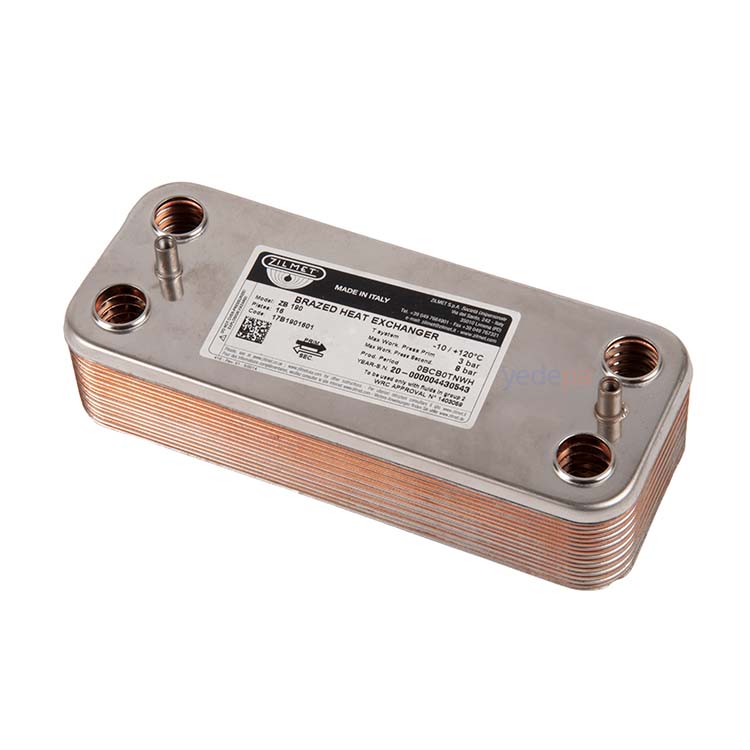
- 14-Plate Models: Have become standard in medium-capacity (24-28 kW) room-sealed combi boilers. Zilmet 14 Plates 17B2071406 (compatible with Demirdöküm Aden, Baxi, Ariston) and I.T.M 207mm 14 Plates (compatible with Alarko, Ferroli) are the most frequently requested references.
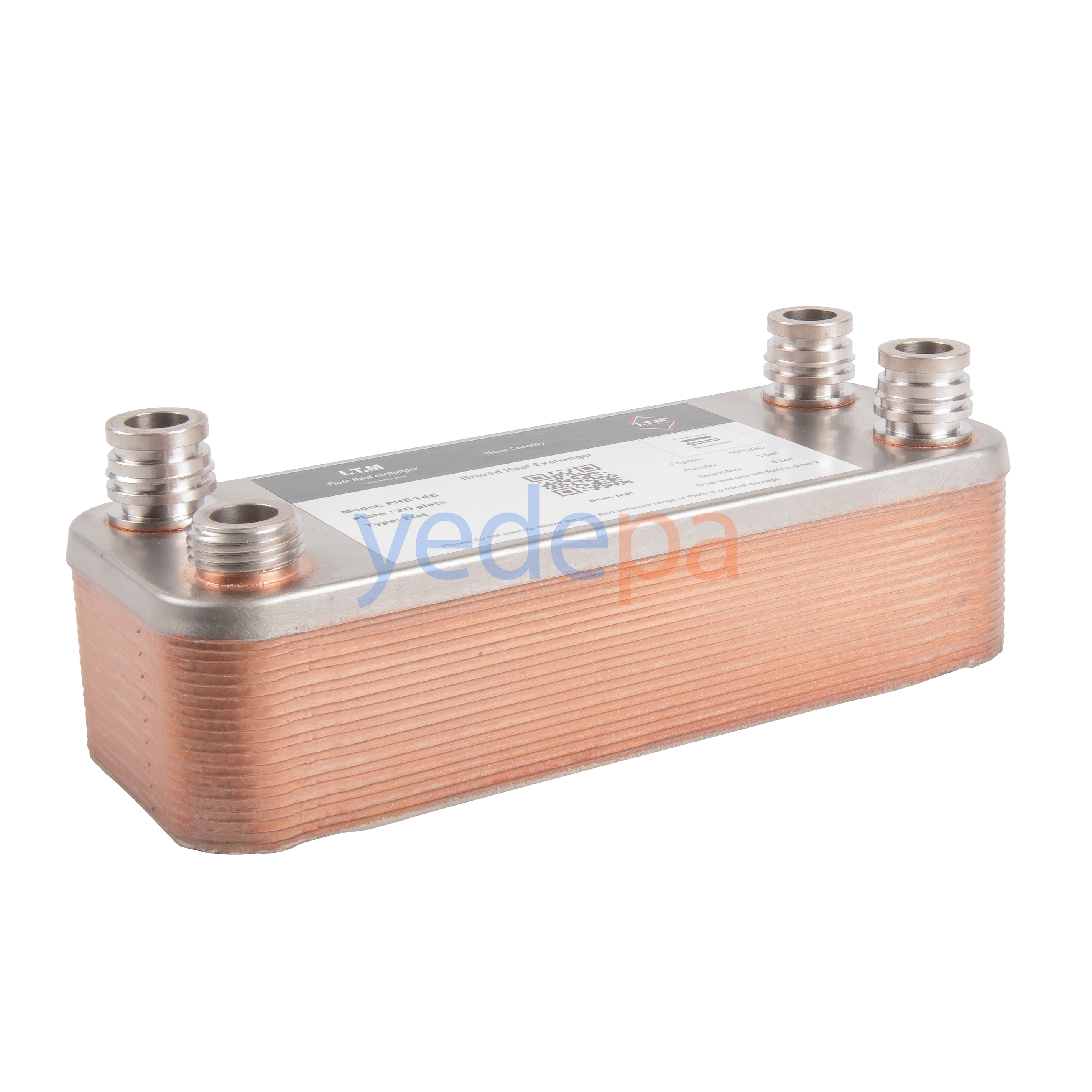
- 16-Plate Models: Used in households that need a high flow rate, with 28-32 kW boilers. Bosch - Buderus Combi Boiler Plate Heat Exchanger 16 P (Swep) and Arçelik - Beretta - Riello Plate Heat Exchanger 16 P (Zilmet) are reliable options in this category. In addition, I.T.M 190mm 16 Plates (compatible with Alarko, Ferroli) is an alternative frequently requested by service companies.
- 20-Plate Models: Found in high-capacity systems and older-generation Vaillant appliances. Vaillant VUW Combi Boiler Plate Heat Exchanger 20P is the classic representative of this segment.
- Bithermal / Recuperator Heat Exchangers: In some semi-condensing systems, they also serve as the main heat exchanger. Bosch Buderus GB012 Combi Boiler Main Heat Exchanger Recuperator (manufactured by Generous) is the leading model of this special group.
Which Plate Heat Exchanger Model Should You Choose? Decision Guide
There are three basic parameters in choosing the right plate heat exchanger: the brand and model of the appliance, the number of plates and the fitting (connection) type. The table below serves as a reference for common combi boiler series.
| Combi Boiler Brand / Series | Recommended Number of Plates | Compatible Yedepa Model |
|---|---|---|
| Vaillant VUW / Turbomax / Atmomax Pro | 20 Plates | Vaillant VUW 20P (I.T.M) |
| Bosch / Buderus 24-28 kW | 16 Plates | Bosch-Buderus 16P (Swep) |
| Bosch / Buderus GB012 Bithermal | Recuperator | GB012 Main Heat Exchanger (Generous) |
| Arçelik / Beretta / Riello | 16 Plates | Arçelik-Beretta-Riello 16P (Zilmet) |
| Demirdöküm Aden / Baxi / Ariston | 14 Plates | Zilmet 17B2071406 14P |
| Alarko / Ferroli (190mm body) | 16 Plates | I.T.M 190mm 16P |
| Alarko / Ferroli (207mm body) | 14 Plates | I.T.M 207mm 14P |
| Immergas Eolo Mini | 12 Plates | Immergas Eolo Mini 12P (Zilmet) |
| Viessmann Vitopend 100 WHE/WHO | 12 Plates (4-Lug) | I.T.M 7817471 12P |
Choosing the wrong number of plates leads to a drop in hot water flow rate or to the combi boiler constantly modulating, which shortens its service life. For this reason, the dimensions and the number of plates on the old heat exchanger must always be verified before replacement.
Plate Heat Exchangers You Can Find at Yedepa.com
In the Yedepa catalog, plate heat exchangers manufactured by four major brands are offered with both the original code information and the list of compatible combi boilers. Featured models in stock:
- Bosch Buderus GB012 Combi Boiler Main Heat Exchanger Recuperator (Semi-Condensing / Bithermal, manufactured by Generous)
- Immergas Eolo Mini Combi Boiler Plate Heat Exchanger 12 P (Zilmet)
- I.T.M Combi Boiler Plate Heat Exchanger 190mm 16 Plates (compatible with Alarko, Ferroli, with 1/2-3/4 male fittings)
- I.T.M Combi Boiler Plate Heat Exchanger 207mm 14 Plates (compatible with Alarko, Ferroli)
- Bosch - Buderus Combi Boiler Plate Heat Exchanger 16 P (Swep)
- Arçelik - Beretta - Riello Combi Boiler Plate Heat Exchanger 16 P (Zilmet)
- Vaillant VUW Combi Boiler Plate Heat Exchanger 20P (I.T.M)
- Plate Heat Exchanger Compatible with Vaillant VUW, VCK, VCW, Turbomax, Atmomax Pro (I.T.M)
- Zilmet 14 Plates 17B2071406 (compatible with Demirdöküm Aden, Baxi, Ariston)
- 4-Lug Plate Heat Exchanger 12 Plates ITM 7817471 (compatible with Viessmann Vitopend 100 WHE/WHO)
Each product page clearly shows the list of compatible appliances, the number of plates, the fitting size and the OEM code information. This way, technicians ordering from Yedepa.com can match the right part to the right appliance without error before going to the job site.
Professional Selection Criteria
There are six critical parameters that technicians servicing combi boilers should consider when choosing a plate heat exchanger:
- Brand Reliability: OEM suppliers such as Swep, Zilmet and Generous manufacture factory parts for many combi boiler manufacturers worldwide; this means consistent quality.
- Plate Material: AISI 316L stainless steel plates are much more resistant to chlorinated mains water than 304.
- Brazing Type: Copper brazing is sufficient for standard applications; in regions with aggressive water, nickel-brazed models should be preferred.
- Connection (Fitting) Type: 1/2"-3/4" male fittings are the most common standard; 4-lug flange connections are specific to certain appliances such as Viessmann.
- Number of Plates: Directly proportional to the kW capacity of the appliance. Too few plates cause low flow rate, while too many plates cause unnecessary pressure loss.
- Gasket / O-ring Quality: In 4-lug models, sealing depends on gasket quality; original O-rings should be used.
Use, Installation and Maintenance Recommendations
The average service life of plate heat exchangers is between 5 and 10 years, depending on water hardness and maintenance frequency. The following practices are essential to extend service life:
- Descaling: In hard water regions, circulation should be performed with a chemical pump every 2 years. Scale buildup can reduce heat transfer efficiency by up to 30%.
- Water Softening: For hardness above 15 °F, installing a softening filter in the installation doubles the life of the heat exchanger.
- Correct Installation: When replacing a plate heat exchanger, new gaskets and bolts must always be used; torque values must be applied according to the manufacturer's instructions.
- Air Purging: After installation, air in the system must always be purged; otherwise, local overheating deforms the plates.
- Temperature Setting: Keeping the domestic hot water temperature in the 55-60 °C range both delays scale buildup and saves energy.
Plate Heat Exchanger Failure Symptoms
A plate heat exchanger failure usually shows itself with the following symptoms: hot water from the tap staying lukewarm, central heating water flowing from the tap (perforation), a drop in radiator temperature, constant modulation of the combi boiler, or sudden pressure drops. If these symptoms appear alone or in combination, the heat exchanger should be evaluated with a pressure test and, if necessary, a compatible replacement should be obtained from the Yedepa.com catalog.
Frequently Asked Questions (FAQ)
Q1: How do I know if my plate heat exchanger is scaled up?
If you notice that the hot water flow rate has dropped, the water takes longer to heat up or the combi boiler fires up too often, there is most likely scale buildup. Circulation with a descaling unit for 2-3 hours usually solves the problem; if it does not, the heat exchanger must be replaced.
Q2: Can I install 16 plates instead of 14 plates?
No. The number of plates is calculated by the factory according to the kW capacity of the appliance. Models with more plates create pressure loss and strain the circulation pump.
Q3: What is the difference between the Generous, Zilmet, Swep and I.T.M brands?
All four are OEM suppliers. Swep and Zilmet, of Italian/Swedish origin, supply factory-fitted units to combi boiler manufacturers worldwide. I.T.M has a strong distribution network and a wide range of equivalents in Turkey. Generous, on the other hand, specializes in special bithermal and recuperator models.
Q4: Is the plate heat exchanger covered by a warranty?
All plate heat exchangers you buy from Yedepa.com are covered by the manufacturer's warranty. Manufacturing defects not caused by installation errors are covered by the warranty.
Q5: I don't know my combi boiler model; which heat exchanger should I buy?
If you share with us the code on the old heat exchanger (for example 17B2071406) or the information on the combi boiler's rating label, the Yedepa technical team will determine the right compatible model for you.
Q6: What is the difference between a 4-lug heat exchanger and a standard 2-fitting heat exchanger?
4-lug models (for example ITM 7817471 for Viessmann Vitopend) have flange connections and require special gaskets. 2-fitting models connect directly to threaded pipes; this is standard in many brands such as Alarko, Ferroli and Bosch.
Conclusion + Yedepa Advantages
The plate heat exchanger is the cornerstone of combi boiler comfort and energy efficiency. A heat exchanger chosen with the right brand, the right number of plates and the right connection type both provides the end user with uninterrupted hot water comfort and protects the reputation of the service technician. Yedepa.com offers technicians the latest models of the Generous, Zilmet, Swep and I.T.M brands in stock. It stands out in the sector with extensive compatibility lists, OEM code matching, a B2B support team focused on technicians and service companies, and a fast shipping infrastructure.
For every combi boiler brand you encounter in the field, you can find the right plate heat exchanger in the Yedepa.com catalog within seconds and verify compatibility through our technical support line. Yedepa.com is with you as the practical answer to the professional HVAC world's slogan right part, right time, right price.
? Related Guides
- Combi Boiler Gas Valves | Honeywell & Sigma Original Models
- Flue Fans - Combi Boiler Fan Motor Models | Yedepa
- Combi Boiler Expansion Vessel Models and Selection Guide
- 3-Way Groups: Combi Boiler Hydro Block Selection Guide
- Combi Boiler Turbines and Readers | Water Flow Sensor Guide
🛒 Plate Heat Exchangers at Yedepa.com — Featured Products
The most preferred professional products, selected from our stock. Review and order now.