
Categories
Categories
My Cart
We use cookies in line with legal regulations to improve your shopping experience. For details, see our Cookie Policy.
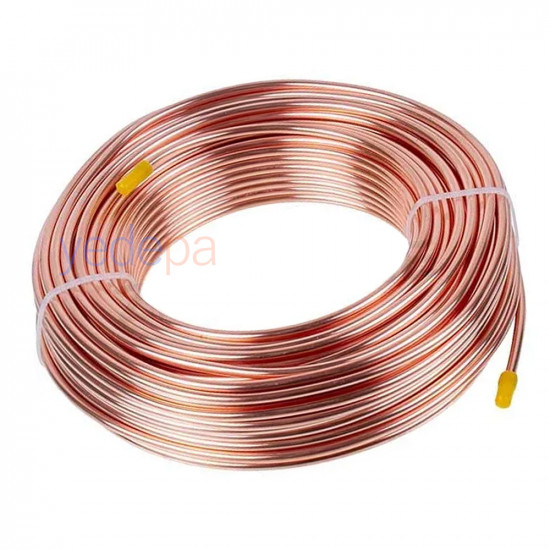
1/6–1/4 HP Copper Capillary Tube Ø0.90 × Ø1.90 mm – Capillary Tube, 15 kg and Multiples

1/6–1/4 HP Copper Capillary Tube Ø0.90 × Ø1.90 mm – Capillary Tube, 15 kg and Multiples

  • Stock: In Stock
  • Brand: OEM
  • Model: 23.01.011
$32.49 (VAT incl.)
Ex Tax: $27.07
This product has a minimum quantity of 15
Fast Dispatch
Shipped from Türkiye by international express courier (see delivery page)
Secure Shopping
Your card details cannot be seen by anyone, including our staff.
Shipping
Your discounted shipping rate is calculated in the cart.

Copper capillary tube is a fixed-bore copper tube with an inside diameter of Ø0.90 mm and an outside diameter of Ø1.90 mm. In small and medium-capacity refrigeration circuits it acts as the expansion device: it throttles the high-pressure liquid refrigerant coming from the condenser down to evaporator pressure.

Capillary Tube: The Fixed-Bore Expansion Device of Small Refrigeration Circuits

Unlike a thermostatic expansion valve (TXV), it has no moving parts; the throttling effect is determined entirely by the inside diameter and length of the tube. As a result it does not fail, needs no adjustment and is very low in cost. On the other hand, its capacity is fixed — it cannot adjust itself when the load changes, so it is used in systems with a largely constant load.

This size is typically chosen for refrigerators and small freezers. When the compressor stops, the capillary tube allows the circuit pressures to equalize; therefore it can be used with RSIR-start (low starting torque) compressors.

Technical Specifications

  • Inside Diameter: Ø0.90 mm | Outside Diameter: Ø1.90 mm | Wall Thickness: 0.500 mm
  • Material: Electrolytic copper (Cu-DHP), refrigeration grade
  • Applications: Refrigerators, freezers, display cabinets, bottle coolers, water dispensers and small commercial refrigeration circuits
  • Compatibility: R134a, R600a, R290, R404A and other common refrigerants
  • Sales Unit: 15 kg and multiples (coil) — price is per kilogram
  • Delivery Form: In coils, clean and capped
  • 🔧 Length calculation is critical: Even with the same inside diameter, if the tube is too short there is overfeeding (the evaporator floods, liquid reaches the compressor); if it is too long there is underfeeding (capacity drops, excessive superheat). The length is determined by the compressor capacity, the refrigerant type and the operating range.
  • ✂️ Cutting method: Do not cut the capillary tube with a saw or side cutters — the burr narrows the bore and blocks the tube. Use a capillary tube cutter, or score it and snap it; check the bore after cutting.
  • 🧊 A filter drier is essential: A filter drier must always be fitted at the inlet of the capillary tube. The most common cause of failure is blockage by moisture and dirt; because the bore is so small, even the smallest particle stops the flow.
  • 🌡️ Heat exchange with the suction line: If part of the capillary tube is placed in contact with and soldered to the suction tube (heat exchanger effect), efficiency increases and liquid return to the compressor decreases.
  • Do not let solder run inside when brazing and purge with nitrogen; oxide residue blocks the capillary tube.

What does the "1/6–1/4 HP" at the start mean?

In the trade, capillary tubes are referred to by the horsepower (HP) of the compressor they match. "1/6–1/4 HP capillary" means that this bore is typically used in a circuit running with a 1/6–1/4 horsepower compressor — it is not the power of the tube itself.

The logic is simple: as the compressor gets bigger, the amount of refrigerant that must circulate in the circuit increases, so a capillary tube with a larger bore is needed. Common equivalents:

  • Ø0.80 mm → 1/6 HP  ·  Ø1.00 mm → 1/4 HP  ·  Ø1.20 mm → 1/3 HP  ·  Ø1.30 mm → 1/2 HP
  • Ø1.50 mm → 3/4 HP  ·  Ø1.80 mm → 1 HP  ·  Ø2.00 mm → 1.5 HP

⚠️ This is a starting point, not a strict rule. The behavior of a capillary tube is determined as much by its length as by its bore; in addition, the refrigerant type (R134a, R600a, R290…) and the operating range (freezer / cooler) change the result. Even two systems of the same horsepower may need different lengths. For an exact selection, refer to the system manufacturer's table or a circuit calculation; if you are fitting the same tube as the one removed, measure its length exactly as well.

Be the first to write a review for this product.

Write a review

Note: HTML is not translated!
Bad           Good

Loading...

Unlimited Blocks, Tabs or Accordions with any HTML content can be assigned to any individual product or to certain groups of products, like entire categories, brands, products with specific options, attributes, price range, etc. You can indicate any criteria via the advanced product assignment mechanism and only those products matching your criteria will display the modules.

Also, any module can be selectively activated per device (desktop/tablet/phone), customer login status and other criteria. Imagine the possibilities. 

Prices are shown in US dollars for reference, converted at the current exchange rate. Payment is charged in Turkish lira (TL); the amount on your card statement may differ slightly. Türkçe